A sober reminder of the danger and power of the coastal seas in Newfoundland and Labrador are the stories and relics of shipwrecks along the route.
We saw first-hand historic and current examples of ships aground and heard stories of the important roles the coast guard, lighthouses, and the fishing community played in saving lives and property in sea disasters. Shipwrecks resulted from many causes: severe weather, fog, navigation errors, collisions, fires, and torpedoes from German battleships and U-boats.
No precise data are available on the total number of ship and plane wrecks that ring the coasts of Newfoundland and Labrador. Guestimates are in the thousands. The Shipwreck Preservation Society of Newfoundland and Labrador has formally documented more than 800 ship and aircraft wrecks, along with many detailed historical accounts. Their map of known wrecks visually reveals the density of these wrecks in certain areas, the type of ship or aircraft, and likely reasons the ships sunk.
The oldest example we encountered was the loss of an early Basque ship believed to have sunk in Red Bay, Labrador, in 1565. On the basis of extensive underwater archeology by researchers and Parks Canada, the entire ship was excavated, mapped, and ultimately returned to its resting place in the sea. This work has produced a scale model of the Red Bay sunken ship, remarkable in its sophistication and size for shipping whale oil (a capacity of about 1000 barrels) and supplies from Labrador to Northern Spain. The Red Bay National Historic Site also exhibits an exact restoration of a Basque whaling boat, a chalupa, also recovered from the waters in Red Bay.
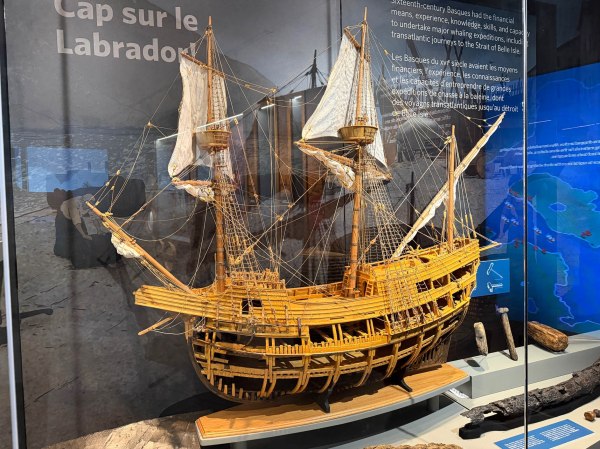
Model of Basque Ship, sunk 1565
On the shores of Gros Morne National Park near Cow Head we were able to touch the remains of the S. S. Ethie, a steam and sail ship that was grounded on the rocks in a fierce winter storm in December 1919. A rescue orchestrated by locals lifted all of the passengers to safety via a rope trolley from ship to cliff. Even an infant was lifted in a mailbag over the ocean to shore.
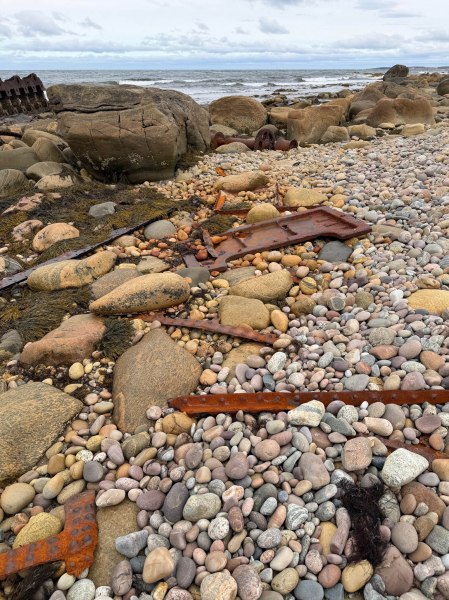
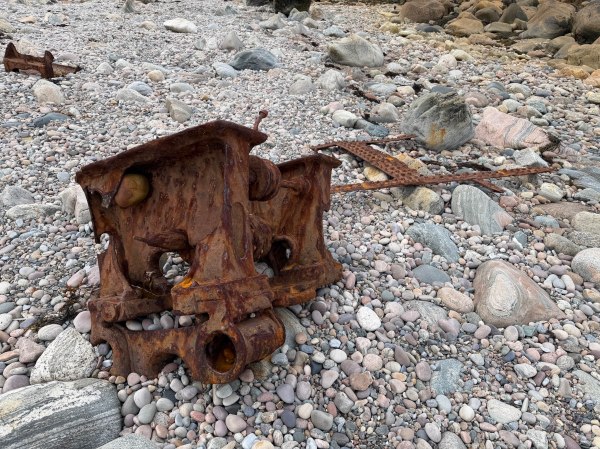
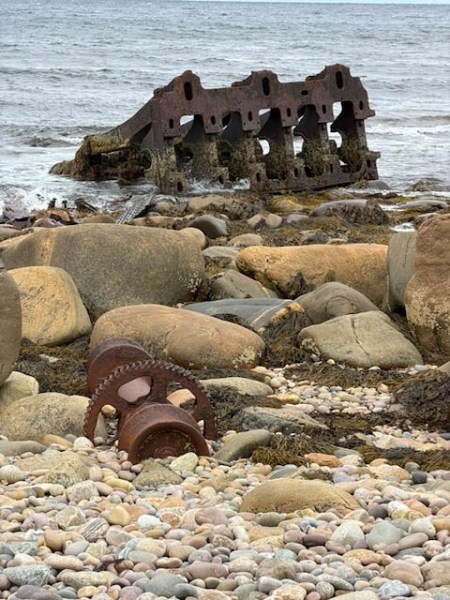
Remains of the S.S. Ethie, 1919
Visiting Lark Harbor, we came across the wreck of the MSC Baltic III, beached in February 2025, run aground after the loss of power in a winter storm. We visited Lark Harbor in 2019 and hiked over a mile to Cedar Cove. The effects on the waterfront resulting from this marine disaster were stunning. An extraordinary salvage operation has been underway to remove fuel oil, cut the ship into pieces, and transport the remains over land. The salvage operation is so big it required major excavation and construction of roads to haul large containers and ship segments off the shore. After encountering workers from the salvage company Resolve Marine in a local bar, we learned more about the global scale of marine salvage and recovery. Understanding this global industry has been a window into how frequent and consequential marine disasters continue to be.
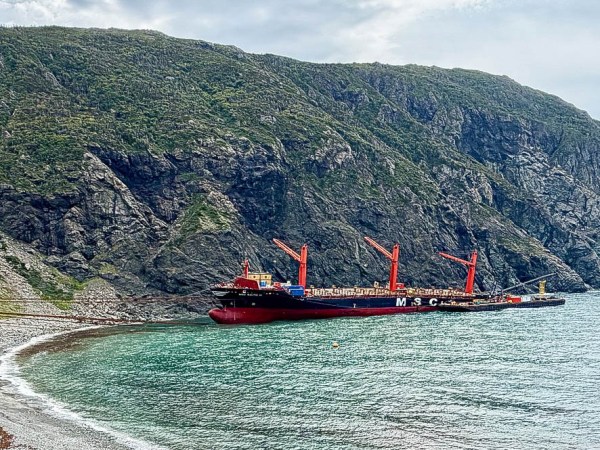
Salvage of MSC Baltic III, Cedar Cove


