What was the largest city in Illinois in the 1830s? (Hint: it was not Chicago)
What was the site of the first degree-granting college, the first medical school, and the first state mental hospital?
Where was one of the first women’s colleges in the United States (the Illinois Conference Female Academy, later McMurray College)?
What was the site of the first free high school in Illinois?
What city is the home of Illinois School for the Deaf and School for the Visually Impaired?
What Illinois city was known as the “Athens of the Midwest?”
What midwestern city was the home of leading fabric and clothing makers in the country, one of the largest record producers in the world (pressing records and producing casettes, CDs, and DVDs for the Beatles, Garth Brooks, and the Capitol Record Club)?
What city in Illinois was one of the largest producers of Ferris Wheels and amusement equipment in the country?


What city in Illinois was both an important stopping point for the Underground Railroad (nine sites) and marker along the Potawatomi Indian Trail of Death?
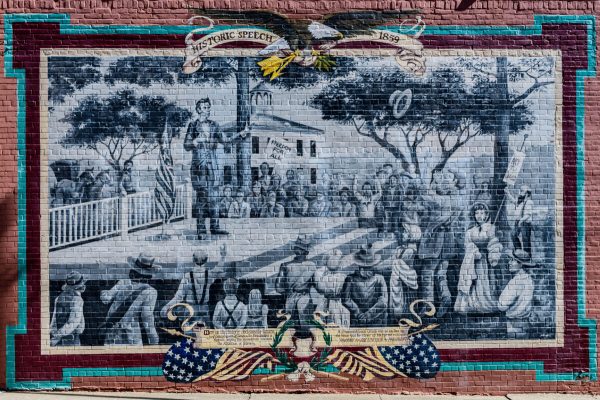
What was the site of one of the most important early antislavery speeches by Abraham Lincoln, promoting the presidential candidate John Fremont?
What city supports the oldest continuously published newspaper in the State of Illinois?
What city is described in Mary Chapin Carpenter’s (grammy album) song, John Doe #24?
The answers are not Chicago, Springfield, Peoria, Rockford, or Champaign, but rather a relatively obscure city in the middle of the state, Jacksonville, Illinois, now with a population of less than 18,000. It seems like an unlikely site for an early seat of higher education, industry, and trade, since it is not on any obvious rivers or trade routes and hasn’t any other unique geographical advantages.

However, Jacksonville has an extraordinarily interesting history. After being designated as the county seat in 1825, the city rapidly developed, establishing the physical layout of a town square and grid, and urgently built churches, stores, and taverns. By 1834, the population numbered roughly 1,800 residents. It was originally settled by Puritans from the Northeast looking for farmland.
Importantly, Jacksonville became the site of numerous early religious and educational institutions. Illinois College was founded in 1829 by a Presbyterian minister, John M. Ellis, and soon staffed by a group of seven Yale Divinity graduates (“the Yale Band”) who set down roots at the new college and in Jacksonville itself. Illinois College, still thriving, educated many outstanding political and religious leaders, including William Jennings Bryan.

A Methodist missionary, Peter Cartwright, supported the creation of the Illinois Conference Female Academy, which eventually would become MacMurray College. Unfortunately, MacMurray closed its doors in 2020 after 174 years, one of many liberal arts colleges unable to financially sustain itself in the face of declining enrollments, low endowments, intense competition, and COVID.
The Jacksonville Female Academy was founded in 1830 and later absorbed into Illinois College, as was the Illinois Conservatory of Music. Many other educational institutions were established in Jacksonville, including the Young Ladies Atheneum, the Jacksonville Business College, Lincoln Land Community College, Rout College (a Catholic institution), and Whipple Academy (a prep school).

Jacksonville also became an important pioneer and center for health and human services. Illinois College created the first medical school in the state, though it closed in 1848. The State of Illinois established its first School for the Deaf, State Asylum and Hospital for the Insane, and Institution for the Education of the Blind in Jacksonville, and legacies of these pioneering institutions all continue to exist in the community.
There is an interpretation that Jacksonville maintained many of the norms and progressive values of its original religious New England pioneers deep into its history. Indeed the nickname “Athens of the Midwest” is reflected in the community’s classical architecture (even the construction of a large Greek amphitheater on the occasion of its centennial in 1925) and the reputation that Jacksonville gained for leading education, political activism, and enlightened political leadership in 19th-century Illinois.
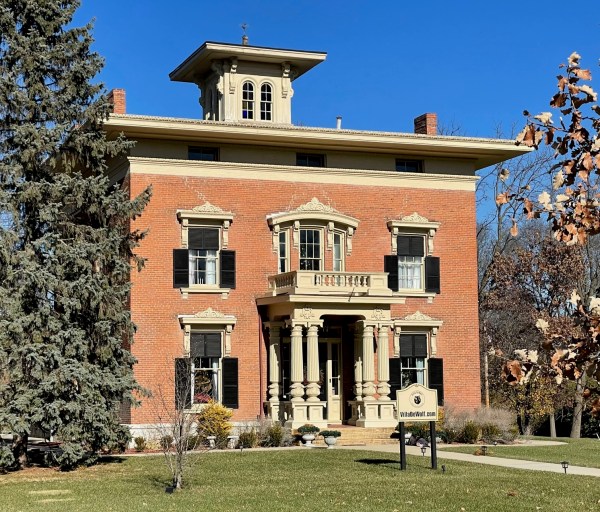
Jacksonville served as an important stop on the Underground Railroad and was a significant player in the abolitionist movement. At Illinois College, President Beecher (brother of Harriet Beecher Stowe) was a major spokesperson for the movement, two college houses served as stops, and college students were indicted for harboring slaves. In 1856 Abraham Lincoln visited town to give an important two and a half hour speech attacking slavery, commemorated in a mural in the town square.
For such a relatively small community, Jacksonville’s economy has been diverse and storied. Agriculture and cattle linked to early rail lines and subsequently stimulated complementary businesses such as slaughterhouses and tanneries. The Capps Mills became one of the largest fabric mills and clothing manufacturers in the country. In the late 19th century, Jacksonville had thirteen cigar factories. The Eli Bridge Company, originally a bridge-building company, evolved into one of the world’s largest manufacturers of ferris wheels and in 1955 broadened its products to other amusement rides. In the 1960s, Capital Records opened what would become a large pressing plant (later EMI) to respond to the huge U.S. demand for the Beatles, Pink Floyd, Garth Brooks and other major recording artists. Alas, the plant ceased operations in 2013, and the facilities now serve as a Goodwill distribution center.

Happening upon Jacksonville was one of these accidents of itinerary on our way west from Chicago to Kansas City. We wanted to avoid going through St. Louis and stayed on back roads to its north. Nothing on the map or in our time in Illinois prepared us for the richness and remarkable history of this small but important community. Jacksonville is a midwest pearl, with so much evidence of its past, its values, and its architectural vibrancy on display. At the same time, its businesses and institutions — those thriving and those departed — are a microcosm of the shocks and threats of the modern economy. Jacksonville is also a case study in the junctures and redirects of history: it lost the competition to become the state capital of Illinois, and it lost in the competition to be the home of the University of Illinois (to Champaign Urbana). Imagine if either of these two monumental siting decisions had gone differently….
We loved this place, this Athens in Illinois, and hope to go back.
Highly recommended: Betty Carlson Kay and Gary Jack Barwick, Jacksonville, Illinois: The Traditions Continue (Charleston, South Carolina: Acadia Press Images of America Series, 1999).

 Betsy and Eddie's Van Life
Wonderful report, thank you!
LikeLike
Sounds like you found a real hidden gem — the benefit of traveling on backroads and Blue Highways. Happy Trails! — David and Sandi
LikeLike